NFL Draft Board: Rankings, Picks & Top Prospects 2026
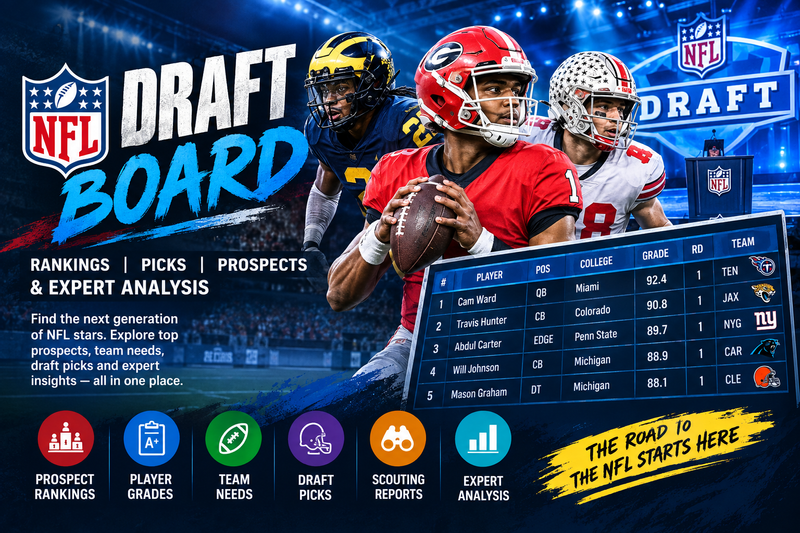
NFL Draft Board: Rankings, Picks, Prospects & Expert Analysis
✅GET NOW YOUR BEST IPTV SERVICE✅
✅GET NOW YOUR BEST IPTV SERVICE✅
The NFL Draft Board is one of the most useful resources for football fans who want to understand how teams evaluate college prospects and make draft-day decisions. It brings together prospect rankings, player grades, positions, team needs, draft picks, and scouting information in one place.
Whether you are following the NFL Draft for your favorite team, researching potential rookies, preparing for fantasy football, or simply tracking the next generation of NFL stars, an updated NFL Draft Board can help you understand which players are rising, which prospects are falling, and where teams could find value.
The 2026 NFL Draft featured 257 selections, with official draft information and prospect evaluations available through the NFL's Draft Tracker.
What Is an NFL Draft Board?
An NFL Draft Board is a ranking system used to evaluate and prioritize eligible college football prospects before and during the NFL Draft.
At the professional level, draft boards can be extremely detailed. NFL teams evaluate players based on athletic ability, game production, position, physical measurements, football intelligence, medical information, character, scheme fit, and long-term potential.
NFL.com has explained that team draft boards typically contain important player information such as height, weight, speed, arm length, hand size, medical information, and other evaluation details. Teams can also maintain an overall ranking of prospects to determine their preferred selections.
For fans, media organizations, analysts, and fantasy football players, the concept is similar but usually presented in a much simpler format.
A typical public NFL Draft Board may include:
Overall prospect ranking
Player name
Position
College
Player grade
Projected draft round
Team selection
Draft pick number
Strengths and weaknesses
Scouting report
Athletic measurements
Draft status
The goal is to make it easier to compare prospects and understand their potential NFL value.
Why the NFL Draft Board Matters
The NFL Draft is not simply about selecting the most famous college player. Every team enters the draft with different roster needs, coaching philosophies, schemes, salary-cap considerations, and long-term plans.
That is why an NFL Draft Board is so important.
For example, one team may rank an offensive tackle as its highest remaining prospect because protecting its quarterback is a major priority. Another team may rank a defensive lineman higher because it needs additional pass-rushing talent.
This means there is rarely one universal ranking that every NFL team follows.
The public draft board provides a general evaluation of prospects, while individual teams create their own internal boards based on their scouting processes and football philosophies.
💎 Premium IPTV Service – Fast & Reliable 📺
💎 Premium IPTV Service – Fast & Reliable 📺
NFL Draft Board vs. Mock Draft
Although the terms are sometimes used together, an NFL Draft Board and a mock draft serve different purposes.
A draft board ranks players based primarily on their perceived talent and value.
A mock draft predicts which players will be selected by specific teams.
For example:
NFL Draft Board:
Quarterback A
Edge Rusher B
Offensive Tackle C
Wide Receiver D
Mock Draft:
Team A — Quarterback A
Team B — Offensive Tackle C
Team C — Edge Rusher B
Team D — Wide Receiver D
The draft board answers the question, “Who are the best prospects?”
The mock draft answers, “Who will each team select?”
Both are valuable, but they should not be confused.
How NFL Teams Build a Draft Board
Creating a professional draft board is a long process that involves scouts, coaches, general managers, medical staff, analysts, and other members of an NFL organization.
1. College Film Evaluation
Scouts watch extensive game film to evaluate how prospects perform against different levels of competition.
They look at technique, decision-making, athleticism, consistency, competitiveness, and how players respond in difficult situations.
A player's statistics are important, but film can reveal details that statistics cannot.
2. Athletic Testing
Teams also examine physical and athletic measurements.
Depending on the position, evaluators may consider:
40-yard dash
Vertical jump
Broad jump
Three-cone drill
Short shuttle
Bench press
Arm length
Hand size
Height
Weight
These measurements can provide additional context about a prospect's athletic profile.
3. Production
College production remains an important part of prospect evaluation.
Quarterbacks may be evaluated on passing efficiency, decision-making, accuracy, and touchdown-to-interception production.
Running backs can be evaluated through rushing efficiency, explosiveness, receiving ability, and ball security.
Wide receivers may be examined for receptions, yards, touchdowns, separation, contested catches, and route-running ability.
However, production is only one part of the evaluation.
4. Position-Specific Skills
Every position requires a different evaluation process.
For example, offensive tackles need strong pass protection, balance, hand placement, footwork, and physical strength.
Cornerbacks require coverage skills, speed, anticipation, change-of-direction ability, and ball awareness.
Quarterbacks require accuracy, processing ability, arm strength, pocket awareness, leadership, and decision-making.
A good NFL Draft Board therefore considers the specific requirements of each position.
5. Medical and Character Evaluation
Professional teams also investigate medical history and character.
Injuries can affect a prospect's draft position, while off-field concerns can influence a team's willingness to select a player.
These factors may not always be visible in a public ranking but can have a significant impact on a team's internal draft board.
Understanding NFL Draft Prospect Grades
Many draft boards use player grades to communicate a prospect's projected NFL value.
The exact grading system varies by organization.
A higher grade generally indicates greater confidence in a player's ability to succeed at the professional level.
NFL.com, for example, publishes prospect grades and detailed player analysis through its Draft Tracker. The 2026 tracker includes player grades, physical measurements, athletic scores, production information, and scouting evaluations.
However, a player grade should not be treated as a guarantee.
Football is highly dependent on coaching, scheme, opportunity, injuries, competition, and player development.
A prospect with a high draft grade can struggle, while a later selection can eventually become an important NFL starter.
How to Read an NFL Draft Board
Reading a draft board is relatively simple once you understand the key categories.
Overall Rank
The overall rank indicates where a prospect stands compared with other eligible players.
For example, a player ranked No. 8 is generally considered a higher-value prospect than someone ranked No. 45.
Position Rank
Position rankings compare players at the same position.
A prospect may be ranked 25th overall but first among all centers, for example.
Player Grade
The grade provides an estimate of the player's expected NFL value.
Different websites and analysts use different grading systems, so grades should ideally be compared within the same evaluation system.
Draft Projection
A draft projection estimates when a player could be selected.
Common categories include:
Top 10
First round
Second round
Day 2
Day 3
Late-round prospect
Undrafted free agent
Team Fit
Team fit considers whether a player's abilities match a team's roster, coaching system, and positional needs.
This is especially important because a player's ideal team may not necessarily be the team selecting earliest.
🔍 Explore More Streaming Guides
🔍 Explore More Streaming Guides
What Makes a Prospect Rise on the NFL Draft Board?
A player's position on a draft board can change considerably during the pre-draft process.
Several factors can influence movement.
Strong Combine Performance
An impressive NFL Scouting Combine performance can improve a prospect's athletic profile.
Elite speed, explosiveness, agility, or strength can encourage teams to reconsider a player's potential.
Excellent Pro Day
College pro days give prospects another opportunity to demonstrate athletic ability and position-specific skills.
Strong workouts can generate additional interest from NFL scouts.
Improved Film Evaluation
Sometimes deeper film study reveals strengths that were initially overlooked.
A prospect who demonstrates consistent technique, football intelligence, or versatility may move higher as the draft approaches.
Injury Concerns
Injuries can have the opposite effect.
Even talented prospects can slide if teams believe a medical issue could affect their availability or long-term development.
Interviews and Character Evaluation
Teams often conduct extensive interviews with prospects.
Leadership, preparation, competitiveness, communication, and decision-making can all influence an evaluation.
What Causes a Prospect to Fall?
Draft boards can change for many reasons.
A prospect may fall because of:
Injury concerns
Poor athletic testing
Inconsistent game film
Questions about position fit
Limited experience
Competition concerns
Character issues
Scheme limitations
Technical weaknesses
Importantly, falling on a draft board does not automatically mean a player lacks NFL talent.
Sometimes a player falls simply because the league values another position more highly or because several teams have different priorities.
NFL Draft Board and Team Needs
One of the biggest mistakes fans make is assuming that every team should simply select the highest-ranked player available.
NFL teams must balance talent with roster construction.
Consider a hypothetical situation where a team has an elite quarterback, two established wide receivers, and significant holes along the offensive line.
Its draft board may rank a wide receiver slightly higher than an offensive tackle, but the team's front office could still decide that the tackle provides greater immediate value.
This is why draft strategy often involves a combination of:
Talent + positional value + team need + scheme fit + long-term potential.
NFL teams also prepare for multiple draft scenarios because selections can change rapidly through trades and unexpected picks.
Best Available Player vs. Positional Need
The debate between selecting the best available player and drafting for positional need is one of the most common discussions surrounding the NFL Draft.
Best Available Player
This strategy focuses on selecting the highest-ranked player remaining on the team's board.
The advantage is that teams can prioritize talent rather than reaching for a position.
Positional Need
This approach focuses on filling a weakness on the roster.
If a team desperately needs a starting cornerback, it may prioritize that position even when another highly rated player is available.
A Balanced Approach
Most successful draft strategies require balance.
Teams need talented players, but they also need those players to fit the roster and coaching system.
The best draft decisions often occur when talent and need intersect.
🚀 Find Your Perfect IPTV Plan →
🚀 Find Your Perfect IPTV Plan →
Why Draft Boards Change After the NFL Draft
Once the draft is completed, analysts can compare their pre-draft rankings with actual selections.
The 2026 NFL Draft Tracker provides official information on selections, including player, position, team, and pick number.
Post-draft analysis can reveal:
Which highly ranked prospects were selected early
Which players fell unexpectedly
Which teams received strong value
Which teams reached for positional needs
Which late-round prospects could become starters
Which draft classes appear strongest
This information is useful when evaluating how accurately a draft board predicted the market.
How Fans Can Use an NFL Draft Board
You do not need to be an NFL scout to benefit from a draft board.
Follow Your Favorite Team
Track your team's needs and compare available prospects before each selection.
Compare Prospects
Use rankings to compare players at the same position.
Track Draft-Day Movement
When a player moves significantly higher or lower than expected, investigate why.
Follow Team Strategy
Compare a team's selections with its pre-draft needs.
This can help you understand whether the organization prioritized immediate roster improvement or long-term development.
Prepare for Fantasy Football
Rookie rankings can also be useful for fantasy football research.
Quarterbacks, running backs, wide receivers, and tight ends selected early in the draft often receive significant attention from fantasy managers.
NFL Draft Board FAQs
What is an NFL Draft Board?
An NFL Draft Board is a ranking system used to evaluate and prioritize prospects entering the NFL. It can include player grades, positions, physical measurements, scouting information, and projected value.
Who creates an NFL Draft Board?
NFL teams create their own internal draft boards using information from scouts, coaches, general managers, analysts, medical staff, and other evaluators.
Is an NFL Draft Board the same as a mock draft?
No. A draft board ranks prospects according to perceived talent and value, while a mock draft predicts which teams will select those players.
What is the best way to use an NFL Draft Board?
Use it to compare prospects, understand positional value, monitor draft-day movement, evaluate team selections, and identify potential sleepers.
Can an NFL Draft Board change?
Yes. Draft rankings can change as new information becomes available, including game-film evaluation, athletic testing, medical reports, interviews, and team feedback.
Does the highest-ranked player always get drafted first?
No. Teams have different draft boards and priorities. A player ranked highly by one analyst may have a different ranking on another team's board.
Final Thoughts on the NFL Draft Board
The NFL Draft Board provides a valuable framework for understanding one of the most important events in professional football.
It helps fans move beyond simple player rankings and explore the factors that influence NFL decision-making. From college production and athletic testing to positional value, team needs, medical evaluations, and scheme fit, the draft process involves much more than choosing the most recognizable player.
The most useful draft board is one that combines rankings with meaningful context.
For the latest official player information, draft selections, prospect grades, and team results, NFL.com's Draft Tracker provides detailed 2026 draft data and player evaluations.
Whether you are following the draft for your favorite NFL team, researching prospects, analyzing team strategy, or preparing for fantasy football, keeping an updated NFL Draft Board can make the entire draft process easier to understand.
As new prospects emerge and NFL teams continue evaluating future talent, draft boards will remain one of the best tools for tracking the players who could become the next generation of NFL stars.